
A shore-fishing plan can start with a tide table, but a tide table does not tell the whole story. Water level rises and falls; tidal current moves water horizontally. For a cook hoping to bring home a legal catch, confusing those two ideas can lead to poor timing assumptions and an unnecessary sense that dinner is guaranteed. A better plan records what the nearest official current station predicts, checks local conditions and rules, and treats any fish kept for the table as a bonus.
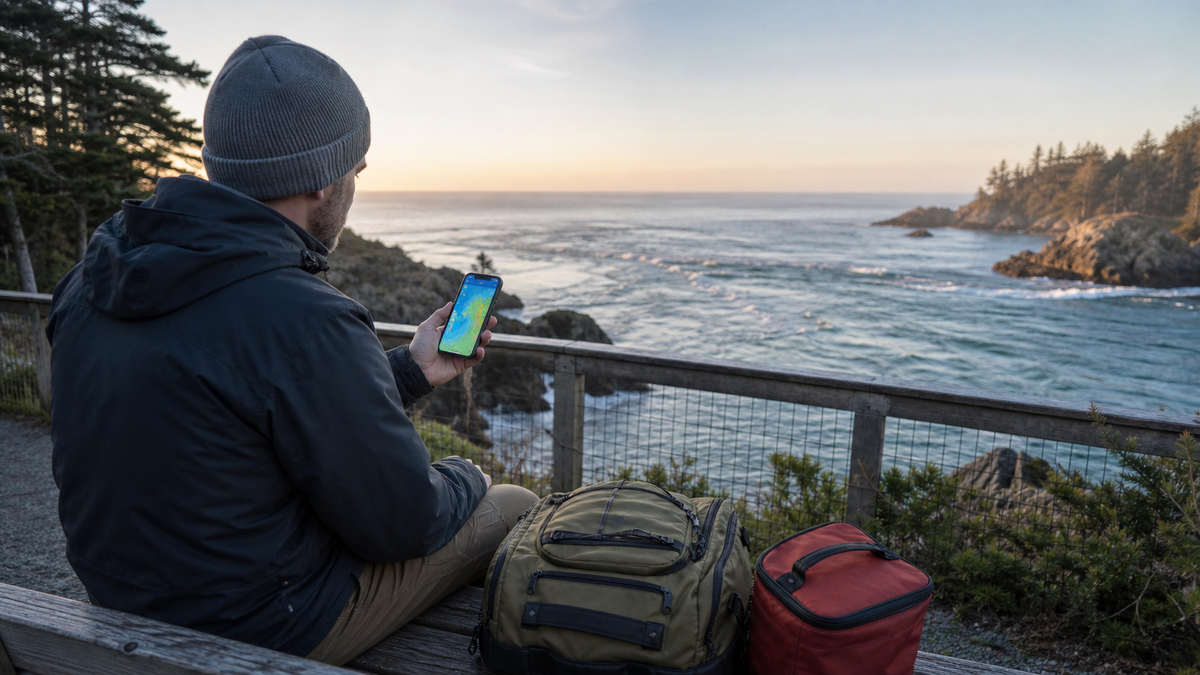
This guide is a source-first worksheet for that process. It does not predict fish behavior, replace a marine forecast, or decide whether a shoreline is safe. NOAA explains that currents vary with more than the tide alone, and a prediction belongs to a particular station. Use the steps below to organize information before leaving home, then follow current warnings, posted access limits, and the rules issued by the agency that manages the fishery.
Separate Water Level From Current Direction
NOAA defines tide as the vertical rise and fall of water and current as horizontal water movement. A rising tide therefore does not automatically mean that every nearby channel, inlet, or shoreline has the same current direction at the same moment. Coastline shape, channel geometry, wind, and other local factors can affect what happens at a particular place. That distinction is the foundation of a useful planning note.
The words flood and ebb describe tidal-current direction. NOAA’s tidal currents tutorial describes flood as movement toward land and ebb as movement toward sea. It also explains that a reversing current can pass through a slack-water interval while changing direction. Those definitions are more useful than assuming that “high tide” or “low tide” names the current at every nearby spot.
For a focused explanation of station predictions, direction labels, and what a chart can and cannot establish, review TideCue’s guide to tidal current direction for anglers. Use it as a reading aid, then return to the official station page for the actual prediction.
Build the Plan Around One Official Station
Open the NOAA current-predictions map and search by station name, place, or station ID. Record the exact station rather than copying only a time into a text message. NOAA’s current-predictions help explains that a station listing can include times and speeds for maximum and slack currents. Keeping the station name with the time prevents a prediction from being separated from the location it describes.
A compact planning record can use five fields:
| Field | What to record | Why it matters |
|---|---|---|
| Station | Official name and ID | Keeps the prediction tied to its source |
| Prediction date | Local date and time zone | Prevents day or time-zone mistakes |
| Current phase | Flood, ebb, or listed slack period | Describes predicted direction or transition |
| Maximum or slack time | Exact value shown by NOAA | Preserves the station’s published timing |
| Last checked | Your verification time | Shows whether the note is current |
Do not silently substitute the closest tide station for a current station. If NOAA does not publish a current prediction that is meaningfully tied to the place you plan to visit, write “no suitable current station confirmed” in the worksheet. An explicit gap is more useful than a confident estimate built from the wrong data.
Add Forecast, Access, and Regulation Checks
A current prediction is one input, not a go/no-go notice. Before departure, check the current local marine forecast and warnings from the responsible weather office. Confirm whether the intended access point is open and whether posted restrictions affect the visit. If conditions or access do not match the plan, choose another activity or location rather than trying to make the worksheet “win” against live information.
Fishing rules are also location- and species-specific. NOAA Fisheries maintains recreational fishing resources, while state, territorial, tribal, and regional authorities may publish the rules that apply at a particular shore. Verify license requirements, seasons, size limits, possession limits, protected species, and area closures with the agency that has jurisdiction. Do not rely on a general article, an old screenshot, or another angler’s recollection.
If you already use a broader timing checklist, the Only Fish Recipes article on how to plan a shore-fishing session around a changing tide can hold the trip-level details. Keep this current-direction worksheet separate so one page does not become a cluttered substitute for several official sources.
Use Shore Observations as Notes, Not Proof
Once at the shore, record observable facts: the time, the location from which you observed, the direction that visible surface material appeared to travel, and whether wind or waves made that observation hard to interpret. Do not convert one surface clue into a precise current speed. NOAA uses dedicated instruments and station methods for current measurements; casual observation is useful as a note about the scene, not as a replacement measurement.
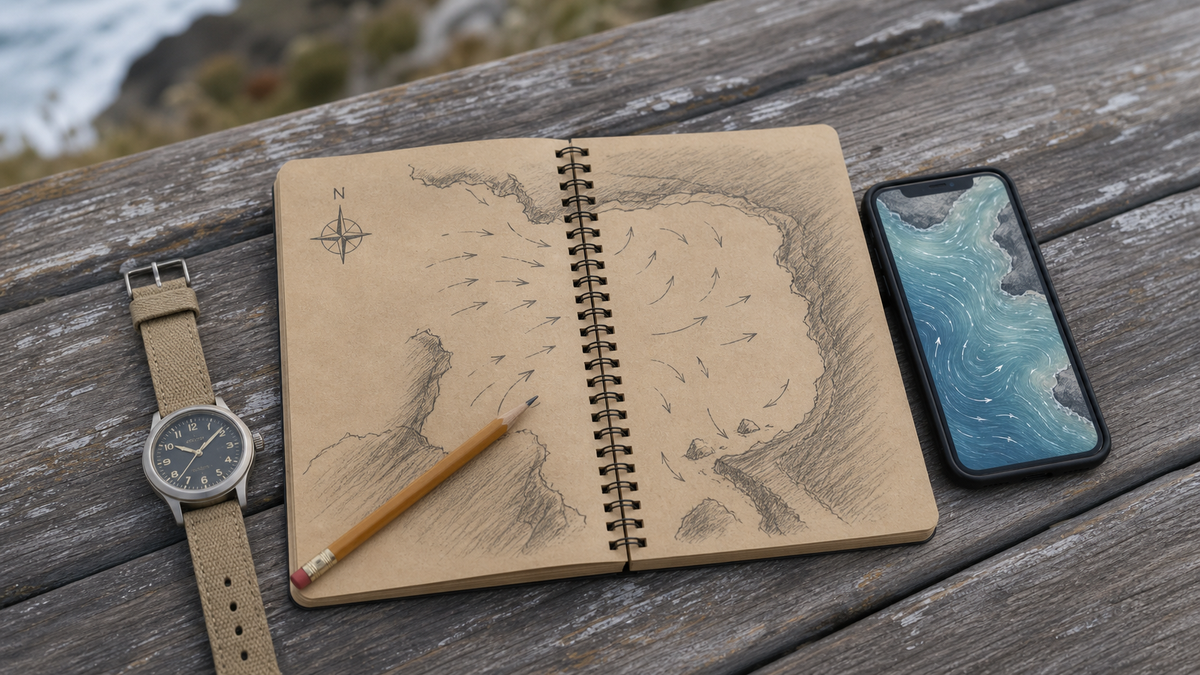
A simple field sketch can include a shoreline outline, a north arrow, the station named in the worksheet, and arrows showing only what was visibly observed. Mark uncertainty. If different parts of the water appear to move differently, record that rather than forcing one arrow across the whole page. This creates a repeatable trip log without presenting a personal observation as official data.
Keep the Meal Plan Independent From the Catch
For a recipe site, the most practical current-planning lesson is culinary: never make the household meal depend on a fish being caught and legally retained. Choose a pantry meal or previously purchased ingredient before leaving. The fishing trip can then remain an outdoor activity, while the dinner plan remains dependable.
If a legal fish is retained, follow the handling guidance issued for that species and jurisdiction. This article does not prescribe dispatch, bleeding, chilling, or storage techniques because those details vary and deserve their own current, authoritative sources. When using purchased seafood or pantry ingredients instead, check product labels and current safety notices. Only Fish Recipes has a separate checklist explaining how home cooks can check seafood and pantry recall alerts.

A Ten-Minute Pre-Departure Readback
- Read the NOAA current prediction and say the station name aloud.
- Confirm the date, local time zone, and listed flood, ebb, maximum, or slack period.
- Check the current local marine forecast and active warnings.
- Confirm access status and the latest rules from the governing fishery agency.
- Write down the backup meal and the conditions that would cancel the fishing plan.
This readback is intentionally short. It cannot eliminate uncertainty, but it makes the source, limits, and fallback visible before the trip. Save the completed note with the date. On a later outing, start with a new official prediction rather than copying the old times forward.
Frequently Asked Questions
Is a rising tide the same as a flood current?
No. Tide describes vertical water-level change, while current describes horizontal water movement. NOAA notes that flood and ebb are current directions. Use a current prediction for the relevant station rather than inferring direction only from high- and low-water times.
Does slack current always happen exactly at high or low tide?
No universal rule should be assumed. NOAA describes slack water as the transition between reversing currents, but timing belongs to the specific current station. Read the station’s listed prediction.
Can floating foam show exact current speed?
No. Surface material can support a qualitative observation, but it is not an instrument reading and may be influenced by wind or local circulation. Record it as an observation, not a precise measurement.
What if there is no useful NOAA current station nearby?
Record that the gap is unresolved. Do not substitute an unrelated station or turn a tide table into a current forecast. Use current local warnings, access information, and official advice when deciding whether to proceed.
Does a favorable current prediction mean fish will be caught?
No. A current prediction describes expected water movement at a station; it does not guarantee fish activity or a catch. Keep the meal plan independent from the fishing outcome.


0 Comments